







The federal solar tax credit 2026 is one of the biggest topics for homeowners considering solar energy. For years, the federal tax credit has helped reduce the cost of installing solar panels, making clean energy more affordable across the United States. However, recent legislative changes mean this valuable incentive is ending for qualifying residential solar projects after the current deadline.
If you’ve been thinking about installing solar panels, now is the time to understand how the federal solar tax credit works, when the solar tax credit deadline arrives, and what it could mean for your investment. Waiting too long could cost you thousands of dollars in lost tax savings.
At Evergreen Solar, we help homeowners throughout California maximize available solar incentives while designing high-performance solar energy systems that provide long-term savings and reliable power. Understanding the federal solar tax credit 2026 can help you make an informed decision before the opportunity expires.
What Is the Federal Solar Tax Credit?
The federal solar tax credit, also known as the Federal Solar Investment Tax Credit (ITC) or the Residential Clean Energy Credit, allows eligible homeowners to claim a percentage of their qualified solar installation costs as a credit on their federal income taxes.
This incentive applies to many parts of a residential solar energy system, including:
- Solar panels
- Solar inverters
- Mounting equipment
- Wiring and electrical components
- Professional installation labor
- Qualified battery storage systems
Unlike a tax deduction, a tax credit directly reduces the amount of federal income tax you owe, making it one of the most valuable financial incentives available for homeowners investing in renewable energy.
Originally introduced in 2006, the federal tax credit on solar has played a major role in expanding solar adoption across the country. Millions of homeowners have used this incentive to lower installation costs while supporting cleaner, more sustainable energy.
How Does the Federal Solar Tax Credit Work?
Many homeowners ask, “How does the federal solar tax credit work?”
The process is straightforward. After purchasing and installing an eligible solar energy system, qualified homeowners can claim a percentage of the total installation cost as a federal tax credit when filing their federal income taxes.
Eligible costs may include:
- Solar equipment
- Installation labor
- Electrical upgrades directly related to the system
- Battery storage equipment that meets current requirements
For example:
If your complete solar installation costs $20,000, a 30% federal solar tax credit could reduce your federal tax liability by $6,000, depending on your individual tax situation.
This significantly lowers the overall cost of going solar and shortens the time it takes to recover your investment through energy savings.
Because tax situations vary, homeowners should always consult a qualified tax professional regarding their individual eligibility and tax obligations.
Who Qualifies for the Federal Solar Tax Credit?
Not every solar installation automatically qualifies. Homeowners should understand the eligibility requirements before beginning a project.
Generally, you may qualify if:
- You own your solar energy system.
- The system is installed on a qualifying residential property.
- The installation is completed before the applicable deadline.
- The system meets federal program requirements.
- You have sufficient federal tax liability to claim the credit.
Many homeowners also ask whether battery storage qualifies.
Under current federal guidelines, qualified battery storage systems installed with eligible residential solar systems can also receive tax benefits if they meet program requirements.
At Evergreen Solar, our team helps customers understand available incentives and works closely with homeowners throughout the installation process to help ensure projects meet current eligibility requirements.
Federal Solar Tax Credit 2026 Status
The federal solar tax credit status 2026 has become an important topic because recent legislative changes have accelerated the expiration of the residential incentive.
Under current law, homeowners planning new solar installations should pay close attention to the project’s completion timeline.
As it stands today, residential systems completed after the applicable deadline may no longer qualify for the current federal tax credit unless future legislation changes the program.
Because federal energy policies can change over time, homeowners should stay informed and verify current requirements before making installation decisions.
For anyone considering solar, the safest approach is to begin planning early rather than waiting until the last minute.
What’s Changing in 2026?
The biggest change is the expiration of the current residential federal solar tax credit 2026 under existing legislation.
This means homeowners who delay their solar installation could lose access to one of the largest financial incentives ever offered for residential solar energy.
Without the federal incentive, homeowners may experience:
- Higher upfront installation costs
- Longer solar payback periods
- Reduced return on investment
- Greater dependence on financing
Although solar remains a smart long-term investment, losing the tax credit increases the initial cost of switching to renewable energy.
For homeowners planning to install solar, acting before the deadline can provide substantial financial benefits.
When Does the Federal Solar Tax Credit Expire?
One of the most common questions is:
When does the federal solar tax credit expire?
Under current legislation, eligible residential solar systems must generally be installed and placed into service before the program deadline to qualify for the available tax credit.
Many homeowners also search:
- When do federal tax credits for solar expire?
- Is the federal solar tax credit going away?
- What is the federal solar tax credit 2026 status?
Based on current federal law, homeowners should not assume the credit will automatically be extended. While Congress could introduce new legislation in the future, no extension is guaranteed.
Why the Federal Solar Tax Credit Matters
The federal solar tax credit has helped make solar energy more affordable for homeowners across the United States. By lowering the upfront cost of installation, it has encouraged millions of families to switch to clean, renewable energy while reducing their monthly electricity bills.
For many homeowners, this tax credit has been the difference between delaying a solar project and moving forward with confidence. As electricity rates continue to increase, the ability to reduce installation costs has become even more valuable.
The federal solar tax credit offers several important benefits:
- Reduces the upfront cost of a solar energy system
- Shortens the solar payback period
- Improves long-term return on investment
- Makes clean energy more affordable
- Increases the value of your home
- Encourages greater energy independence
Even after the tax credit ends, solar remains a smart long-term investment. However, homeowners who qualify before the solar tax credit deadline can maximize their savings and recover their investment more quickly.
How Much Can You Save Before the Deadline?
The amount you save depends on the total cost of your solar energy system. Since the federal solar tax credit is based on a percentage of eligible installation costs, larger systems generally result in greater tax savings.
Here are a few examples:
| Estimated System Cost | Estimated Federal Tax Credit (30%) | Estimated Net Cost* |
|---|---|---|
| $15,000 | $4,500 | $10,500 |
| $20,000 | $6,000 | $14,000 |
| $25,000 | $7,500 | $17,500 |
| $30,000 | $9,000 | $21,000 |
*Estimated values are for illustration only. Actual savings depend on your project costs and individual tax situation.
These savings can significantly reduce your overall investment and shorten the time it takes for your solar system to pay for itself through lower electricity bills.
At Evergreen Solar, we provide detailed savings estimates so homeowners understand the financial benefits of going solar before installation begins.
Financial Impact After the Federal Solar Tax Credit Ends
Once the federal solar tax credit 2026 expires under current law, homeowners may face higher upfront installation costs.
Without the federal incentive, you may experience:
- Higher out-of-pocket expenses
- Larger solar loan amounts
- Higher monthly loan payments
- Longer payback periods
- Reduced overall return on investment
The loss of the credit could also increase demand before the deadline. As more homeowners rush to install solar, installation schedules may fill quickly, permitting timelines may become longer, and equipment availability could become more limited.
Planning early helps reduce the risk of missing the deadline while giving installers enough time to complete your project.
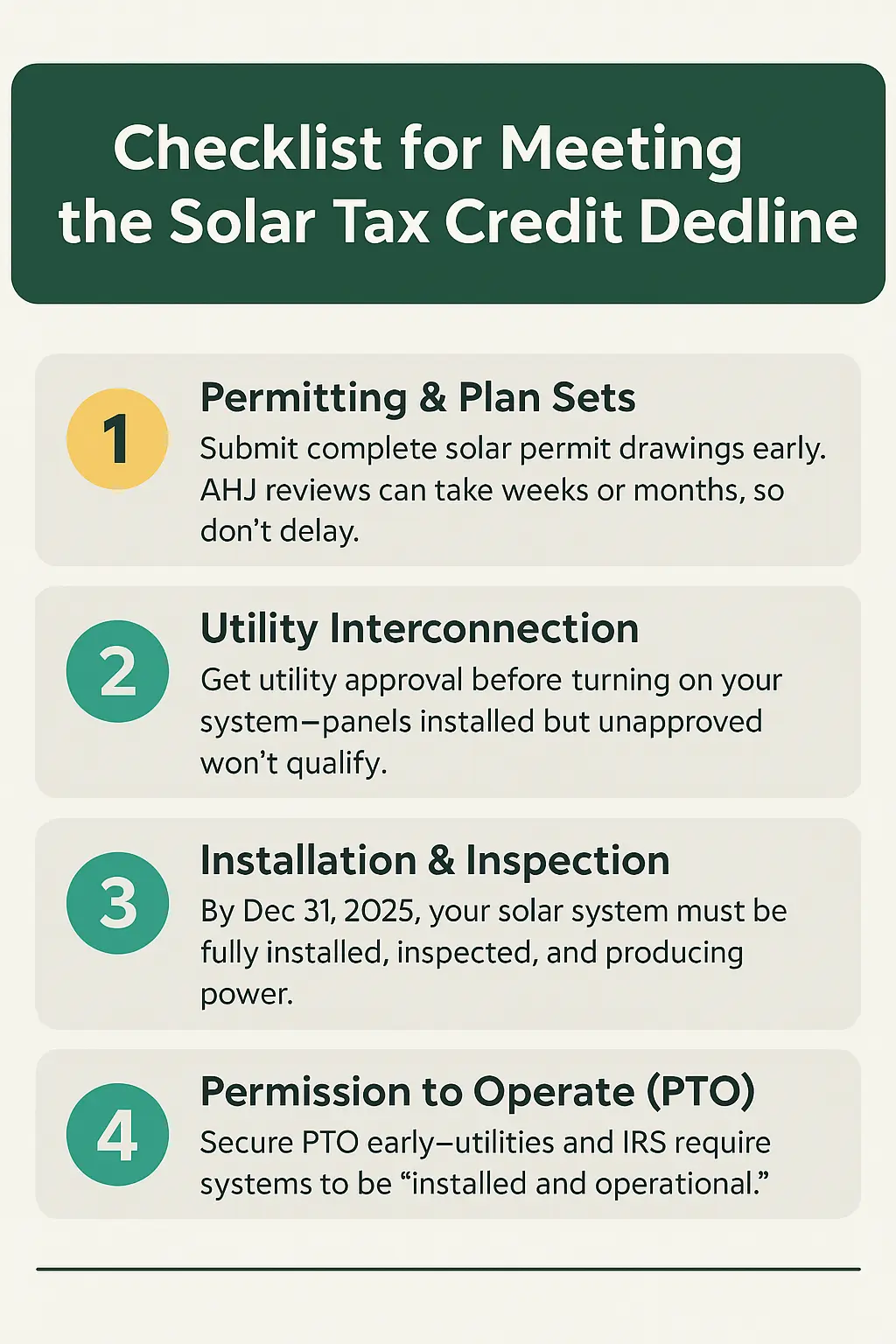
What Homeowners Should Do Before the Solar Tax Credit Deadline
If you’re considering solar, waiting may reduce your opportunity to qualify for available federal incentives. Taking action early gives you more flexibility and helps avoid last-minute delays.
Start Planning Early
A complete residential solar project involves several steps, including:
- Home energy evaluation
- Roof inspection
- System design
- Permit approvals
- Equipment ordering
- Installation
- Utility inspection
- System activation
Depending on your location, this process can take several weeks or even a few months.
Starting early provides enough time to complete each step before the solar tax credit deadline.
Choose an Experienced Solar Installer
Working with a trusted installer is one of the most important decisions you’ll make.
At Evergreen Solar, we guide homeowners through every stage of the process, including:
- Personalized solar consultation
- Custom system design
- Permit coordination
- Professional installation
- Battery storage integration
- System activation
- Ongoing customer support
Our experienced team focuses on delivering high-quality solar solutions that maximize long-term energy savings and help homeowners take advantage of available incentives before deadlines change.
Review Your Financing Options
Solar can be purchased in several ways, including:
- Cash purchase
- Solar loans
- Home improvement financing
Understanding your financing options helps you choose the solution that best fits your budget.
If you’re financing your system, discuss with your lender how the expected federal solar tax credit may affect your loan structure and repayment schedule.
Keep Important Documentation
To claim the federal tax credit, homeowners should maintain organized records, including:
- Purchase agreements
- Installation contracts
- Paid invoices
- System completion documents
- Equipment information
Keeping complete records makes the tax filing process much easier.
Don’t Wait Until the Last Minute
Many homeowners wait until incentives are close to expiring before making a decision.
Unfortunately, this can lead to:
- Longer installation wait times
- Limited installer availability
- Equipment shortages
- Permit delays
- Missing the qualification deadline
Beginning your project as early as possible gives you the best opportunity to qualify under current federal guidelines.
Federal Solar Tax Credit for Businesses
The federal solar tax credit for businesses has also helped commercial property owners invest in renewable energy.
Businesses that install qualified solar energy systems may benefit from federal tax incentives, helping reduce project costs while lowering long-term operating expenses.
Commercial solar projects can provide benefits such as:
- Reduced electricity costs
- Improved energy efficiency
- Lower operating expenses
- Greater sustainability
- Enhanced corporate environmental goals
Business owners should consult qualified tax professionals regarding current eligibility requirements and available federal incentives.
Because federal policies can change, companies considering commercial solar should begin planning as early as possible.
Can the Federal Solar Tax Credit Be Carried Over?
One of the most common questions homeowners ask is:
Can the federal solar tax credit be carried over?
In many cases, if you cannot use the full amount of your eligible federal solar tax credit in one tax year because your tax liability is lower than the available credit, you may be able to carry the remaining credit forward to future tax years, subject to current IRS rules.
Because every homeowner’s tax situation is different, it is always recommended to speak with a qualified tax advisor to understand how the credit applies to your individual circumstances.
California Solar Incentives After 2026
Although the federal solar tax credit 2026 is ending under current legislation, California homeowners may still have access to state, local, and utility programs that help reduce the cost of going solar.
Available incentives vary by location and utility provider and may include:
- Local utility rebate programs
- Net billing or net metering benefits
- Battery storage incentive programs
- Energy efficiency rebates
- Solar financing options
While these programs can lower installation costs, they generally do not provide savings equal to the current federal tax credit. Homeowners should review available incentives before starting a project and avoid assuming they will replace the federal benefit.
At Evergreen Solar, we help homeowners understand available California solar incentives and identify opportunities to maximize long-term savings.
Is Solar Still Worth It After the Tax Credit Ends?
Yes. Even without the federal tax credit, solar energy continues to offer significant long-term value.
Modern solar panels are more efficient than ever, and many homeowners continue to save thousands of dollars over the life of their systems through reduced electricity bills.
Solar can still provide:
- Lower monthly utility bills
- Protection from rising electricity rates
- Greater energy independence
- Increased property value
- Reduced environmental impact
- Reliable renewable energy for decades
Adding a solar battery storage system can provide even greater value by storing excess energy for use during evenings, peak electricity hours, or unexpected power outages.
Although the payback period may become longer after the solar tax credit 2026 changes, many homeowners will still find solar to be a smart financial investment.
Why Choose Evergreen Solar?
Choosing the right installer is just as important as choosing the right solar equipment.
At Evergreen Solar, we are committed to helping California homeowners invest in reliable, high-quality solar energy solutions designed for long-term performance.
Our team provides:
- Free solar consultations
- Customized system designs
- Professional installation
- Premium solar equipment
- Battery storage solutions
- Ongoing customer support
- Honest recommendations based on your energy needs
From your initial consultation through final system activation, we guide you through every step of the process while helping you understand available incentives and project timelines.
Whether you’re installing solar panels for the first time or adding battery storage to an existing system, Evergreen Solar is here to help you make a confident investment in clean energy.
FAQs
Are tax credits ending on 5 April 2025?
No. The federal solar tax credit ends on December 31, 2025, not April 5, 2025.
How long has the solar tax credit been around?
The solar tax credit has been available since 2006.
What is 26 USC 25D?
It’s the U.S. tax law that allows homeowners to claim the residential solar tax credit.
Why are people getting rid of their solar panels?
Usually due to roof repairs, system upgrades, or old equipment, not because solar isn’t worth it.
Get Started Before the Federal Solar Tax Credit Ends
The federal solar tax credit has helped millions of homeowners make the switch to clean, affordable energy. If the current federal solar tax credit 2026 timeline remains in place, delaying your project could mean losing one of the largest financial incentives available for residential solar.
Starting early gives you time to complete permitting, installation, inspections, and utility approval before the solar tax credit deadline. It also helps you avoid delays caused by increased demand as more homeowners rush to install solar before the incentive ends.
At Evergreen Solar, we’re dedicated to helping California homeowners maximize their solar investment with expert guidance, quality workmanship, and dependable customer service. From customized system design to professional installation and battery storage solutions, our team is here to make your transition to clean energy simple and stress-free.
Contact Evergreen Solar today to schedule your free consultation and learn how you can take advantage of available solar incentives before the federal solar tax credit expires.